 Marietta Gutter Specialists
Acworth Gutters Where the Water Has Somewhere to Go
Between Allatoona and Lake Acworth, most lots slope toward the water — and drainage on private land is the owner's job.
Call (770) 678-7045Who owns the drainage on an Acworth lot
Start with the rule that surprises many Acworth homeowners. Under the city code, stormwater systems on private property with no written easement or dedication remain the property owner's legal responsibility; the city maintains only what sits in the right-of-way or in easements it has accepted. Pipes, swales and inlets in a back yard are usually the owner's — and so is whatever roof water feeds into them.
On private land with no written easement: the owner's.
Not sure: the city's Stormwater Division can say, and the property's plat usually shows recorded easements.
Two lakes, and a lot of slope
Acworth sits between two lakes. Allatoona Lake, built by the U.S. Army Corps of Engineers for flood control and hydropower, was in full operation by January 1950 and has 270 miles of shoreline. Lake Acworth, a 260-acre lake next to the historic downtown, drains into it. Homes near either one tend to sit on sloped, wooded lots that fall toward the water.
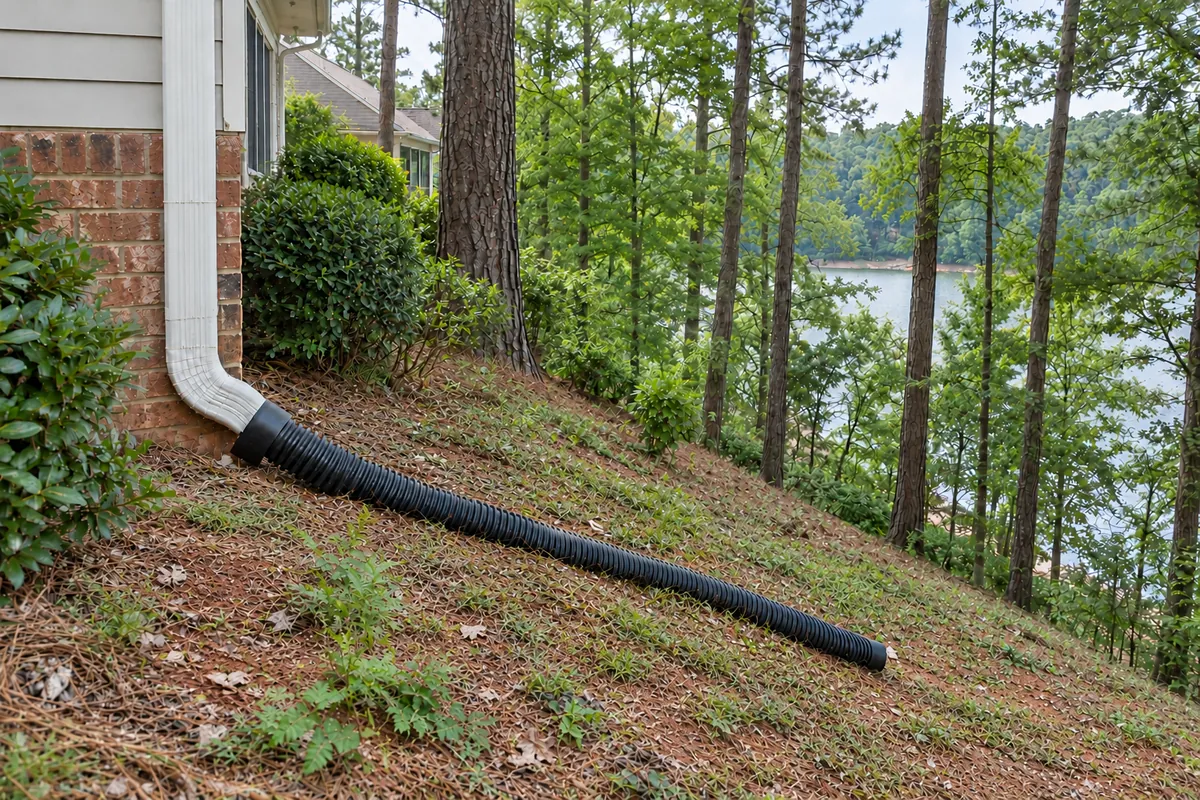
On a slope, where a downspout lets go matters more than usual. Water dumped at the corner of the house runs downhill across the yard and can cut a gully through bare soil in a single storm; Allatoona Creek near Acworth hit 16,600 cubic feet per second in the September 2009 flood, a reminder of how much water these hillsides can move. The fix is to carry downspout water well away from the foundation — the federal Building America guide calls for at least 5 feet onto ground sloping away, or 10 feet or more through a buried line — and to let it out where it can spread and soak in rather than run.
Trees the city protects, and what they drop
Acworth's tree ordinance names the trees it treats as specimens: oaks, hickories and maples at 24 inches in diameter, and tulip poplars, sweetgums and river birches at 30 inches. Those are exactly the trees that fill gutters on lake-area lots, and big ones are there to stay. Work on existing single-family lots is generally exempt, but on a wooded lot the practical answer is to plan for the debris — gutter guards on the runs under the heaviest canopy, and cleanings timed to fall leaf drop.
Before the estimate
- Walk the yard after a storm and note where downspout water ends up.
- Look for washouts, exposed roots or soil piled against the foundation on the downhill side.
- Check the plat or ask the city about any drainage easement crossing the lot.
- Note which roof runs sit under the biggest trees.
Sloped lot, lots of trees?
A local provider can price guards and downspout routing together.
Lot and drainage questions
Can a downspout drain toward a neighbor's yard in Acworth?
Water that leaves one lot and crosses onto another is the kind of situation worth checking with the city before changing anything. The city's Stormwater Division handles drainage questions, and routing roof water to a spot on the same lot where it can soak in avoids the issue entirely.
Does the lake setting change what gutters a home needs?
Not the gutters themselves so much as what happens below them. Lake-area lots are often sloped and wooded, so the main concerns are leaf and needle load, and carrying downspout water across a slope without cutting a channel in the soil.