 Marietta Gutter Specialists
Seamless Gutter Installation
Gutters formed on site to the length of each wall, sized for 50 inches of rain a year and hard July storms.
Call (770) 678-7045Seamless versus sectional
Sectional gutters come in fixed lengths joined every 10 feet or so, and every joint is a seam that can open up. Seamless gutters are formed on site from a coil of aluminum (or steel or copper) by a machine on the installer's truck, so each run is one continuous piece cut to the exact length of the wall. The only seams left are at corners and downspout outlets. Seamless typically adds $3 to $5 or more per linear foot over sectional.
Sizing for Georgia rain
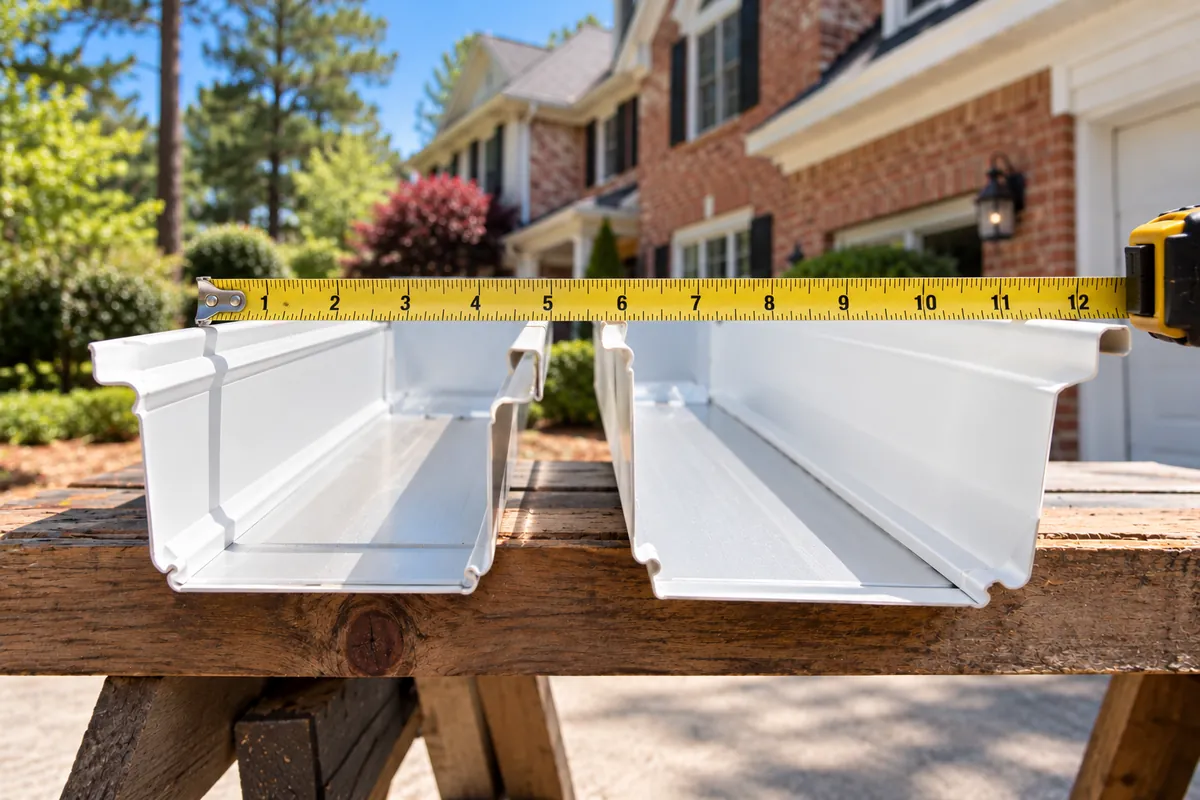
Atlanta averages 50.43 inches of rain a year (NOAA's 1991–2020 normal), with July the wettest month at 4.75 inches — and much of that falls in short, hard summer thunderstorms. Gutters come in 4-, 5- and 6-inch widths, and the DOE Building America Solution Center notes that a larger size conducts more water faster, provided there are enough downspouts to drain it.
Materials
- Aluminum — the standard for seamless systems; won't rust, comes in many colors. Thicker gauges resist ladder dents and storm-limb damage better.
- Galvanized steel — stronger, heavier, and prone to rust once the coating wears.
- Copper — the premium option, usually in half-round profiles on older homes. See copper and half-round gutters.
The installation, step by step
- Measure and inspect. Each run is measured, and the fascia is checked for soft wood.
- Remove the old system and repair any fascia damage.
- Form the gutter on site to the exact length of each run.
- Set the pitch. At least 1/16 inch per foot toward the downspouts, per Building America guidance.
- Hang it. Hidden hangers are screwed into the fascia at close spacing; they hold far better than the old spike-and-ferrule method.
- Place the downspouts — about 1 square inch of downspout per 100 square feet of roof, spaced 20 to 50 feet apart, and routed so water lands away from the house (see downspouts and drainage).
- Seal corners and outlets and test with water.
What seamless installation costs
| Item | Installed cost | Source |
|---|---|---|
| Gutters, overall | $12–$25 per linear foot; $2,200–$5,000 for a typical home | HomeGuide |
| Seamless aluminum | $14–$20 per linear foot | Fixr |
| Seamless copper | $29–$40 per linear foot | Fixr |
| 6-inch instead of 5-inch | +$1–$2 per linear foot | HomeGuide |
| Two-story homes | +$1–$3 per linear foot | HomeGuide |
| Old gutter removal | $50–$200 | HomeGuide |
| Downspouts | $30–$75 each | HomeGuide |
Gauge and color
Aluminum seamless gutters are formed from coil in a few thicknesses. Thicker coil holds its shape better under ladders, falling limbs and the weight of wet debris — worth considering on wooded lots where branches come down every storm season. Color is matched to the trim or fascia rather than the siding in most cases, with downspouts painted or matched to the wall they run down so they disappear against brick or siding.
Where the gutter sits against the roof
A gutter that is hung too low lets water run behind it and down the fascia; too high and water from the shingles shoots past the front in a hard rain. Installers aim for the back of the gutter just below the drip edge flashing, so water leaving the shingles falls into the trough. On older homes without drip edge, adding it during installation stops the slow fascia rot that otherwise follows.
What a good installation estimate includes
- Measured length of every run, number of corners and downspouts.
- Gutter size (5-inch or 6-inch) and material gauge.
- Hanger type and spacing.
- Removal and disposal of the old system.
- Fascia repair, if needed, priced separately.
- Downspout routing — extensions, splash blocks or underground connections.
- Guard options, if wanted, priced as a line item so they can be compared.
Timing a new system
Gutters can be installed in any season around Marietta, since hard freezes are short and infrequent. The practical consideration is the calendar of debris and storms: new gutters going up before the summer thunderstorm season or before fall leaf drop get tested right away, and adding guards at the same time spares them a first season of clogs.
Planning new gutters?
Ask for 6-inch and guard options on the same estimate so the numbers can be compared.
Questions
How much pitch should a gutter have?
The DOE Building America Solution Center recommends at least 1/16 inch of slope per foot of run toward the downspouts. Too little pitch leaves standing water; too much can look uneven from the street on long runs.
How far apart should downspouts be?
The same Building America guidance calls for downspouts at least 20 feet apart but no more than 50 feet apart, sized at about 1 square inch of downspout opening for every 100 square feet of roof.
Do new gutters need new fascia?
Only if the existing fascia is soft or rotted. Installers check it when the old gutters come down; hangers need solid wood behind them, so damaged boards are replaced before the new gutters go up.