 Marietta Gutter Specialists
Pine Needles vs Gutter Guards
Loblolly needles run 6 to 10 inches long and slip into openings a leaf would sit on. Which guard types hold up, and which ones trap them.
Call (770) 678-7045The problem: a long, stiff needle
Clemson's Home & Garden Information Center describes loblolly needles as growing in groups of three, 6 to 10 inches long. Loblolly is the most common pine in Georgia, so around Marietta that is the needle most gutters have to deal with. Pines also drop their older interior needles naturally in the fall, on top of a steady trickle the rest of the year.
A needle that long behaves differently from a leaf. It slides through openings a leaf would sit on, stands upright in coarse screens where it catches more debris, and weaves into brushes and foam.
How each guard type fares
Micro-mesh
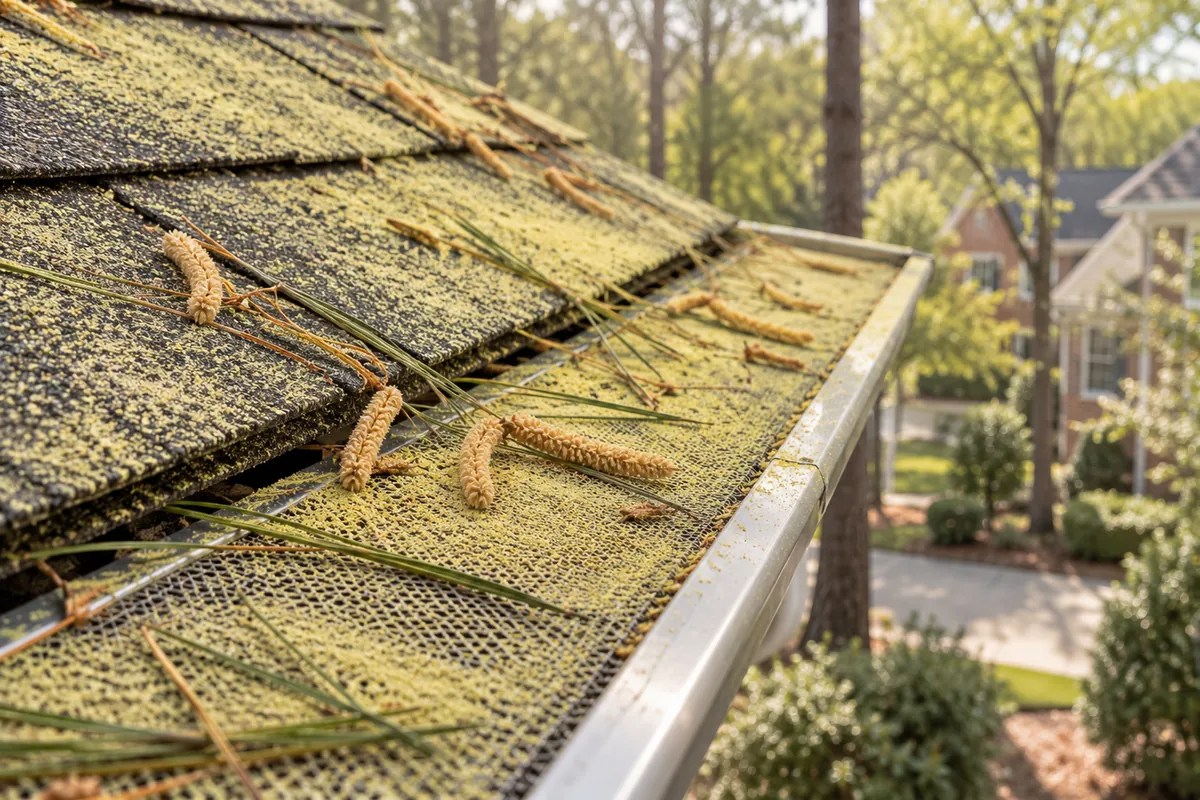
The needle can't enter, so it lies on the surface. On a guard pitched to match the roof, rain and wind move most needles along; on a nearly flat installation they collect. Mesh is the type most often recommended under pines for that reason.
Reverse-curve covers
Needles mostly slide off the front with the water. The weak point is the curved nose: if needles and pollen residue build up on it, water stops following the curve and sheets over the edge.
Perforated screens
Needles land point-first in the holes and stand upright, then catch leaves and more needles around them. Screens with small perforations do better than those with large holes or slots.
Foam and brush inserts
Both trap needles in the gutter by design. Under loblollies they fill and mat quickly and have to be pulled out to clean, which defeats the purpose.
Then comes pollen
Spring adds a second problem. Atlanta's pollen count hit 14,801 grains per cubic meter on March 29, 2025, a record, with pine, oak and sweetgum among the main sources. Pollen is fine enough to pass through most guards, but it can film over the finest mesh after a dry spell. That's a maintenance note rather than a reason to avoid mesh: one rinse after pollen season is usually enough.
The verdict for a Marietta roof under pines
- Heavy loblolly cover: micro-mesh, pitched to match the roof, with an annual rinse.
- Mostly hardwoods, some pine: mesh or a reverse-curve cover both work well.
- Avoid under pines: foam, brush and large-hole screens.
- Either way: sound, properly pitched gutters underneath. A guard on a sagging gutter keeps the sag.
Costs by type are on the gutter cost page, and the gutter guards page covers installation and fit.
Needle and pollen questions
Do pine needles get stuck in micro-mesh?
Rarely through it. The openings in fine mesh are far smaller than a needle's width, so needles lie on top. They can collect there in still weather until wind or rain clears them, especially where the guard is set close to flat.
Does pollen clog fine mesh?
Pollen can leave a film on mesh, particularly after a dry spell in spring. It usually rinses through with rain; a hose rinse at the end of pollen season clears what remains.