 Marietta Gutter Specialists
Gutter Guards Built for Pine Needles and Oak Pollen
Long loblolly needles and fine spring pollen push guard choice in opposite directions. Here's how each type holds up, and what it costs.
Call (770) 678-7045Why guard choice is different under Marietta's trees
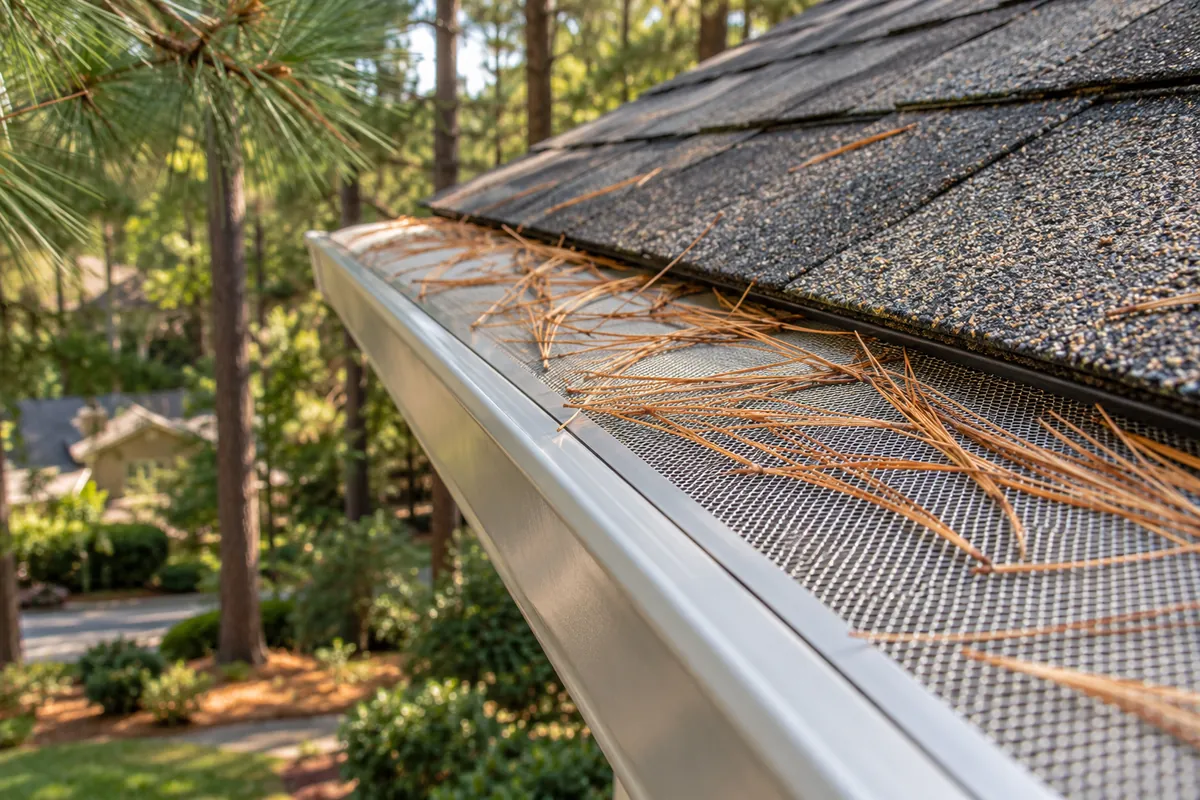
Two debris problems decide which guard works here, and they push in opposite directions. Loblolly pines drop long, stiff needles that slide through wide openings and lodge upright in coarse screens. Spring pollen is the opposite: a fine dust that can film over the finest meshes — Atlanta's count hit a record 14,801 grains per cubic meter in March 2025. A guard that handles one well can struggle with the other, so the right type depends on which one a particular roof sees more.
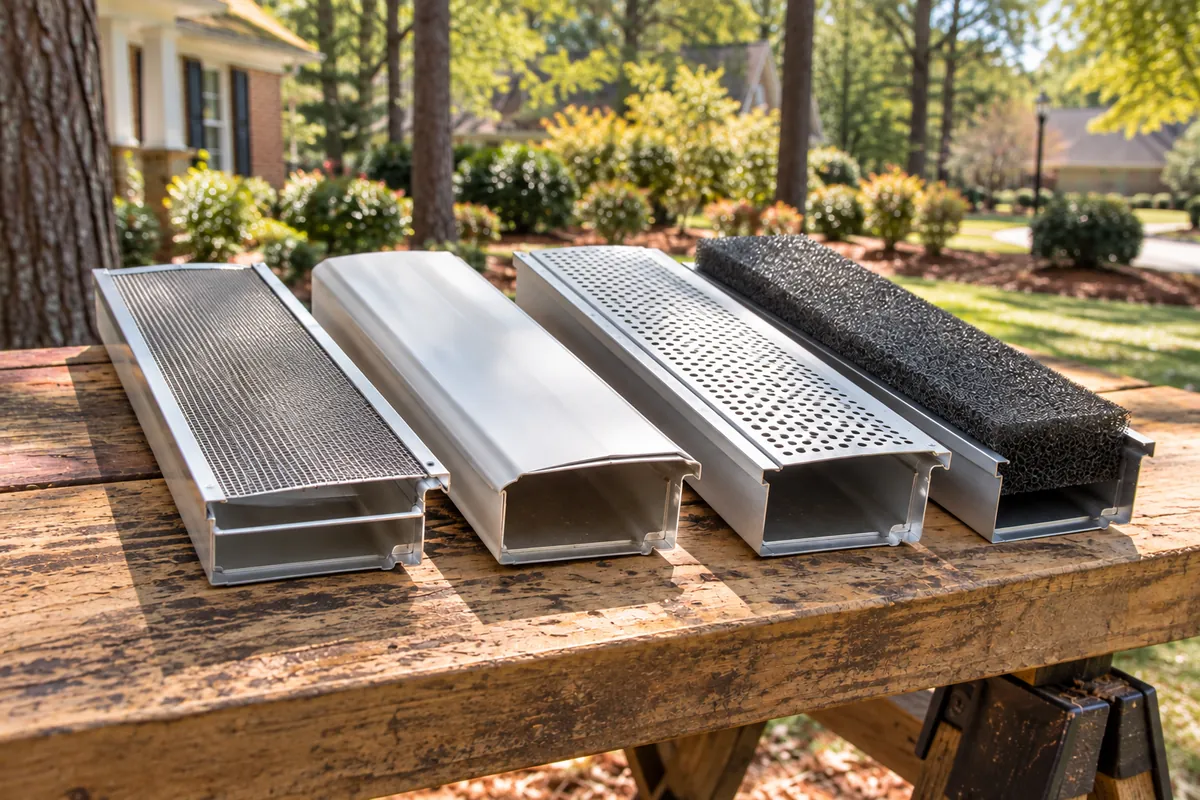
Guard types compared
| Guard type | How it works | Pine needles | Pollen | Reported avg. cost / ft |
|---|---|---|---|---|
| Micro-mesh | Fine stainless mesh over a frame; water passes, debris sits on top | Good — needles rest on top and blow off | Can film over; occasional rinse | $40.50 |
| Reverse-curve (surface tension) | Solid cover; water follows a curved nose into the gutter | Good when the curve stays clean | Fair; residue can disrupt the curve | $41.22 |
| Perforated screen | Metal or vinyl panel with holes or slots | Fair — needles can poke through larger holes | Good | $38.12 |
| Foam insert | Porous foam fills the trough | Poor — needles embed in foam | Poor — holds fine debris | $21.58 |
| Brush | Bristle cylinder sits in the trough | Poor — needles tangle in bristles | Fair | $18.94 |
The performance columns describe how each design handles debris in general; real results depend on fit, pitch and the specific product. For a closer look at needles specifically, see pine needles vs. gutter guards.
Fit matters more than type
The most common reasons guards disappoint have little to do with the brand or style:
- Pitch. Guards sit at an angle set by the roof edge and gutter. Too flat and debris settles; too steep and heavy rain overshoots.
- The gutter underneath. A guard on a sagging or leaking gutter keeps the sag and the leak. On older systems, replacing the gutters at the same time is often the better spend.
- Gutter size. On large roof planes, a 6-inch gutter plus a guard handles summer storms better than a 5-inch gutter alone.
- Corners and end caps. Gaps there let debris and nesting pests back in.
What still needs doing with guards on
Guards reduce cleaning; they do not end maintenance. Mesh can collect a film of pollen and roof grit that needs an occasional rinse, needles can pile on top in still air, and downspouts still benefit from a periodic check. Anyone quoting guards as maintenance-free for good is overselling them.
Tree-heavy lots and two-story homes
Guards pay off most where cleaning is hardest: two-story homes under mature canopy, which describes much of East Cobb and older parts of Marietta. On those roofs every cleaning means a tall ladder on a sloped yard, so cutting the number of visits matters more than on a ranch house with open sky.
How each type installs
Micro-mesh and screen guards usually clip to the front lip of the gutter and either fasten to the fascia or slide under the first course of shingles at the back. Reverse-curve covers install as a hood over the whole gutter, attached at the front and back. Foam and brush inserts simply sit in the trough, which makes them the easiest to install and the easiest to remove — and the least suited to a roof under loblollies. How a guard attaches decides whether it can be lifted for an inspection later, and whether it touches the shingles at all.
Questions worth asking on a guard estimate
- Which guard type is proposed, and how does it attach — to the shingles, the fascia, or only the gutter?
- Will the existing gutters be cleaned, re-pitched and resealed before the guards go on?
- Are the gutters sound enough to carry guards, or should they be replaced first?
- How are corners, valleys and end caps covered?
- What maintenance does the guard still need, and how is it done?
- Is the price per linear foot, and does it include downspout work?
Valleys, corners and the heaviest water
Where two roof planes meet in a valley, water arrives at the gutter faster and in a narrower stream than anywhere else on the roof. That is the spot most likely to overshoot any guard in a heavy storm. Good installations treat valleys differently — a splash guard on the gutter, a larger downspout nearby, or a gutter outlet placed directly below the valley — rather than running the same guard straight through.
Guards and pollen season
Spring is when guards earn their keep and when they need a look. Pine and oak pollen in February through April can settle onto fine mesh as a yellow film; most of it rinses off in the next rain, but a dry spell can leave enough residue to slow water entering the gutter. A rinse from a hose or a soft brush at the end of pollen season, once a year, is usually all a mesh guard needs. Solid covers mainly need the curved nose kept clean so water still follows it.
Replacing gutters soon anyway?
Ask about new gutters and guards together — one estimate, one installation.
Questions
Do gutter guards affect a roof warranty?
It depends on how the guard attaches. Guards that slide under the first row of shingles or are fastened through them can conflict with some shingle manufacturers' installation requirements; guards that clip to the gutter lip and fascia avoid that. The roof's warranty documents are the place to check before choosing.
Do gutter guards work on 6-inch gutters?
Yes. Most guard types are made in 5-inch and 6-inch widths. A 6-inch gutter with a guard is a common pairing on large roofs, since the wider trough carries more water and the guard keeps it from filling.
Can guards go on old gutters?
They can, but a guard fastened to sagging or leaking gutters inherits those problems. When the gutters are near the end of their life, replacing them and adding guards in one job avoids paying to install guards twice.
Will heavy July storms overshoot a mesh guard?
In very intense rain, some water can sheet across any guard on a steep roof. Fine mesh tends to let more water through than solid covers, while reverse-curve covers depend on water following the curve, which can fail when the flow is heavy. Pitch, roof length and installation angle matter as much as the type.
Do guards stop birds and wasps from nesting?
Covered gutters leave birds no open trough to nest in, and most guard types make it harder for wasps to build inside. Gaps at end caps and corners still need to be closed for that to hold.