 Marietta Gutter Specialists
Downspouts That Keep Water Off Red Clay
A gutter only does half the job. Where the downspout lets go decides whether storm water ends up in the yard or against the foundation.
Call (770) 678-7045Why red clay changes the picture
Georgia's red clay gets its color from iron oxides left behind by long-term weathering, and the weathered material beneath it erodes easily when trees and other vegetation are removed. Clay also takes water in slowly. A downspout that dumps a roof's worth of storm water at the corner of the house has nowhere to go but sideways — washing out the bed, staining the brick red, and keeping the soil against the foundation wet.
Options, from simplest to most involved
- Splash blocks — the minimum. They slow water at the outlet but don't move it far.
- Extensions — rigid or flexible pipe that carries water several feet out. Cheap and effective, but in the way of mowing.
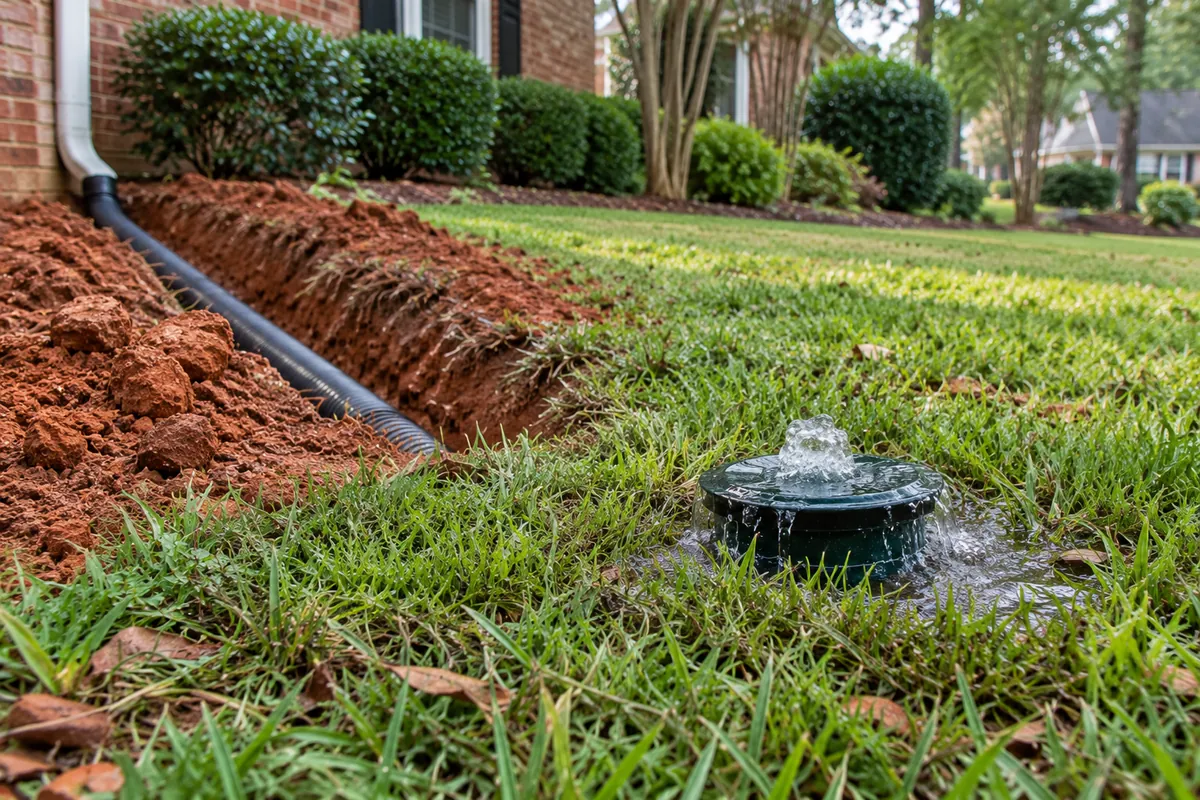
- Underground drains — buried pipe from the downspout to a pop-up emitter in the lawn. Building America recommends at least 0.5 inch of slope per foot for buried lines.
- Rain gardens — a planted bed that soaks water in. The UGA-supported rain garden guide says to place one at least 10 feet from the house, fed by a swale or pipe. On clay, test first: if water stays in a 6–8 inch test hole for 12 hours or longer, the spot isn't suitable.
- Rain barrels — catch some of the flow for watering; they still need an overflow routed away from the foundation.
Downspout count and placement
Undersized or too-few downspouts make gutters overflow even when they're clean. Building America guidance is roughly 1 square inch of downspout per 100 square feet of roof, with downspouts 20 to 50 feet apart. Placement matters as much as count: downspouts that empty onto a driveway or patio sloping back toward the house just move the problem.
Stormwater in Cobb County
Storm drainage is now a line item for Cobb homeowners: the county approved a $4.75-a-month residential stormwater fee starting June 2026 for unincorporated Cobb and the City of Mableton, to fund repairs to its pipe network. Rules on where private downspouts may discharge vary by city and situation; when water is crossing a property line, checking with the city or county first is the safe course.
What it costs
New downspouts run about $30 to $75 each installed, and extensions or splash blocks $10 to $50. Replacing a downspout averages $2 to $4 per linear foot.
Signs of a drainage problem
- A trench or bare patch washed out below a downspout.
- Reddish staining on brick or foundation walls near the ground.
- Mulch or pine straw washed onto walks after every storm.
- Standing water against the house a day after rain.
- Damp crawlspace or basement walls on the side with the downspout.
- Water bubbling up from the joint where a downspout enters an underground pipe.
Driveways, walks and patios
A downspout emptying onto pavement looks tidy but can send water straight back toward the house if the slab slopes that way, and it turns into a slick spot in winter. Moving the outlet to a lawn or bed that falls away from the house, or piping it under the walk, is usually the better fix.
Keeping underground lines working
Buried downspout lines fail quietly. Smooth-wall pipe holds up better than corrugated pipe, which traps debris in its ridges. A clean-out fitting at the top makes flushing easy, and a strainer or guard at the gutter outlet keeps needles and sweetgum balls out of the pipe to begin with. Emitters at the far end should sit at the low point of the yard with room for water to spread.
Washout or staining at the foundation?
A local provider can reroute downspouts and price an underground line.
Questions
How far from the house should a downspout discharge?
The DOE Building America Solution Center recommends downspouts terminate at least 5 feet from the foundation onto ground that slopes away, or into an underground system that carries water at least 10 feet away.
Do underground downspout drains clog?
They can, mainly when gutters send needles, leaves and grit straight into the pipe. A clean-out at the top, a strainer at the downspout and good gutter protection upstream keep them running.