 Marietta Gutter Specialists
Gutters in Marietta's Historic Districts
Like-for-like gutter replacement is exempt from review in Marietta's residential historic districts. Downtown is the exception. The city's own wording, district by district.
Call (770) 678-7045Marietta has five National Register historic districts and three local ones, and gutters are one of the most common exterior jobs on the houses in them. The good news for owners in most districts: the city's rules treat like-for-like gutter replacement as routine maintenance. The exception is downtown. This note sets out which rules apply where, quoting the city's own documents.
Three kinds of historic district
The City of Marietta's historic districts page lists two layers of designation, and a third body covers downtown:
| District | Type | Who reviews exterior work | Like-for-like gutter replacement |
|---|---|---|---|
| Kennesaw Avenue | Local district (designated August 2013, the city's first) | Historic Preservation Commission | Exempt from a Certificate of Appropriateness |
| Church–Cherokee Streets | Local district (also on the National Register) | Historic Preservation Commission | Exempt from a Certificate of Appropriateness |
| Forest Avenue | Local district | Historic Preservation Commission | Exempt (gutters are listed as exempt in the commission's FAQ) |
| Downtown Marietta | Downtown historic district | Marietta Historic Board of Review | Check first — the application covers "any exterior work" |
| Atlanta–Frasier St., NW Marietta St., Washington Ave., Whitlock Ave. | National Register only | No local design review from listing alone | No local review triggered by National Register listing |
What the residential guidelines say about gutters
Both residential district guidelines carry the same exemption. The Kennesaw Avenue guidelines (§6.2) list, among the work that does not need a Certificate of Appropriateness, "the replacement of gutters where the replacement is in the same location and of the same scale". The Church–Cherokee Streets guidelines repeat it in §5.2, and their roof section (§7.12) adds two recommendations worth following anyway: "Historic cornices, gutters, flashing and downspouts should be maintained in good condition," and replacement gutters "should be sensitively designed, installed and located to produce minimal damage" and visual impact. The same note in §7.12 says no certificate is needed for new gutters where none existed before.
The Historic Preservation Commission's own FAQ is shorter still: under items exempt from a certificate, it simply lists "Gutters".
Downtown is different
Properties in the Downtown Historic District come under a separate body, the Marietta Historic Board of Review. Its application states that it must be submitted for any exterior work in the Downtown Historic District. Whether a straight gutter swap counts is a question for the city, not an installer. Planning & Zoning (770-794-5440) is the office the application points to, and asking before work starts costs nothing.
What "same location and same scale" means in practice
- Same location: gutters on the same eaves, downspouts in the same places. Moving a downspout to a different corner of a front porch arguably changes the location.
- Same scale: a gutter of similar size and profile. Swapping a slim half-round for a large K-style changes how the eave reads from the street.
- New gutters where none existed: exempt under the Church–Cherokee note, but the "sensitively designed" recommendation still applies.
Matching the house
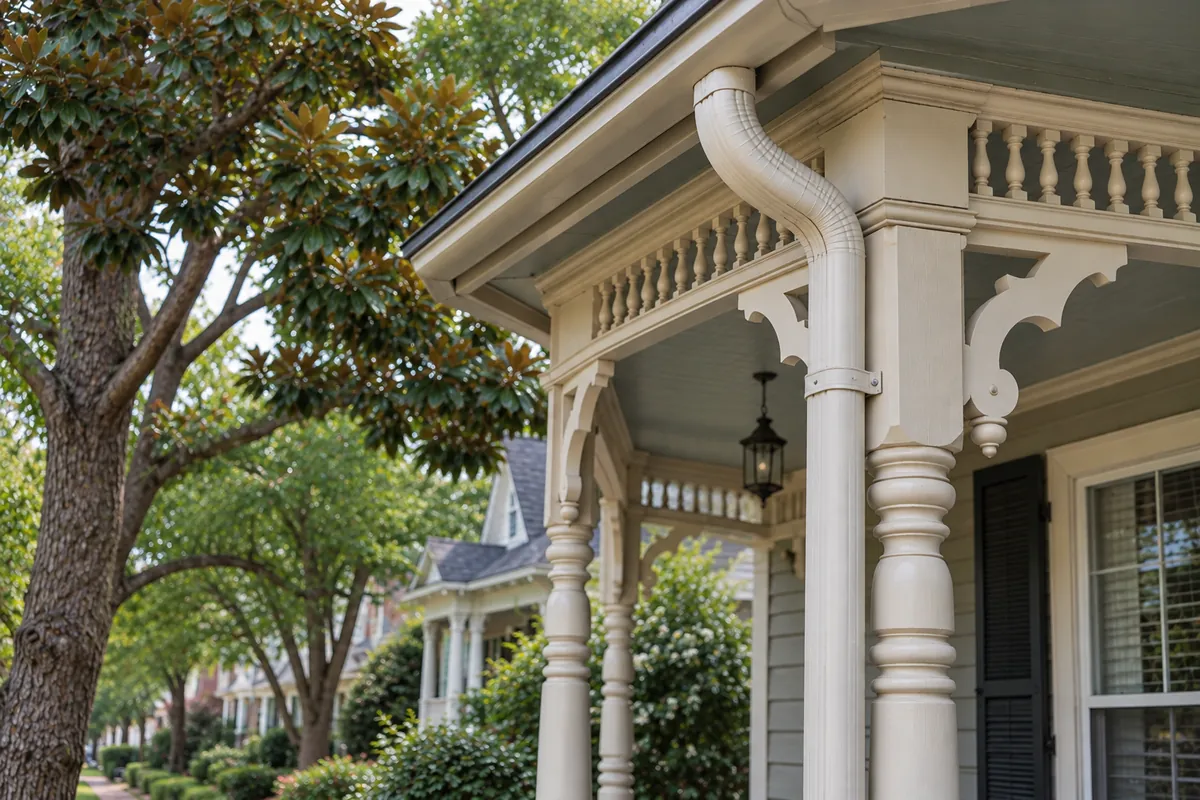
Marietta's historic homes run from Greek Revival through Queen Anne, Colonial Revival and Craftsman, and many were built with half-round gutters and round downspouts rather than the K-style profile standard on postwar houses. Matching the original profile — in copper or in painted aluminum — is the simplest way to keep a replacement within "the same scale." The copper and half-round page has a style-by-style guide.
Before calling an installer
- Confirm which district the house is in, if any, on the city's historic districts page.
- Photograph the existing gutters, downspouts and cornice from the street and up close.
- Note the profile (half-round, K-style, built-in) and material of what's there now.
- If downtown, or if the plan changes location or scale, call Planning & Zoning first.
- Ask the installer to match profile and downspout locations unless there's a reason to change them.
This note summarizes public city documents for general information. It is not legal advice, and the City of Marietta's current rules govern.