 Marietta Gutter Specialists
When Gutters Need Replacing
Rusted seams, rotted fascia and runs that sag no matter how often the hangers are reset: how to tell when repair money stops making sense.
Call (770) 678-7045Seven signs a gutter system is done
- Rusted or split seams that reopen soon after being resealed.
- Cracks or splits along the trough, not just at joints.
- Soft or rotted fascia behind the gutter, often visible as dark stains below it.
- Gutters pulling away from the house in several places, even after hangers are reset.
- Standing water along whole runs because the pitch has sagged out.
- Peeling paint or water marks on siding and brick below the gutter line.
- The wrong size for the roof — overflow every heavy storm even when the gutters are clean.
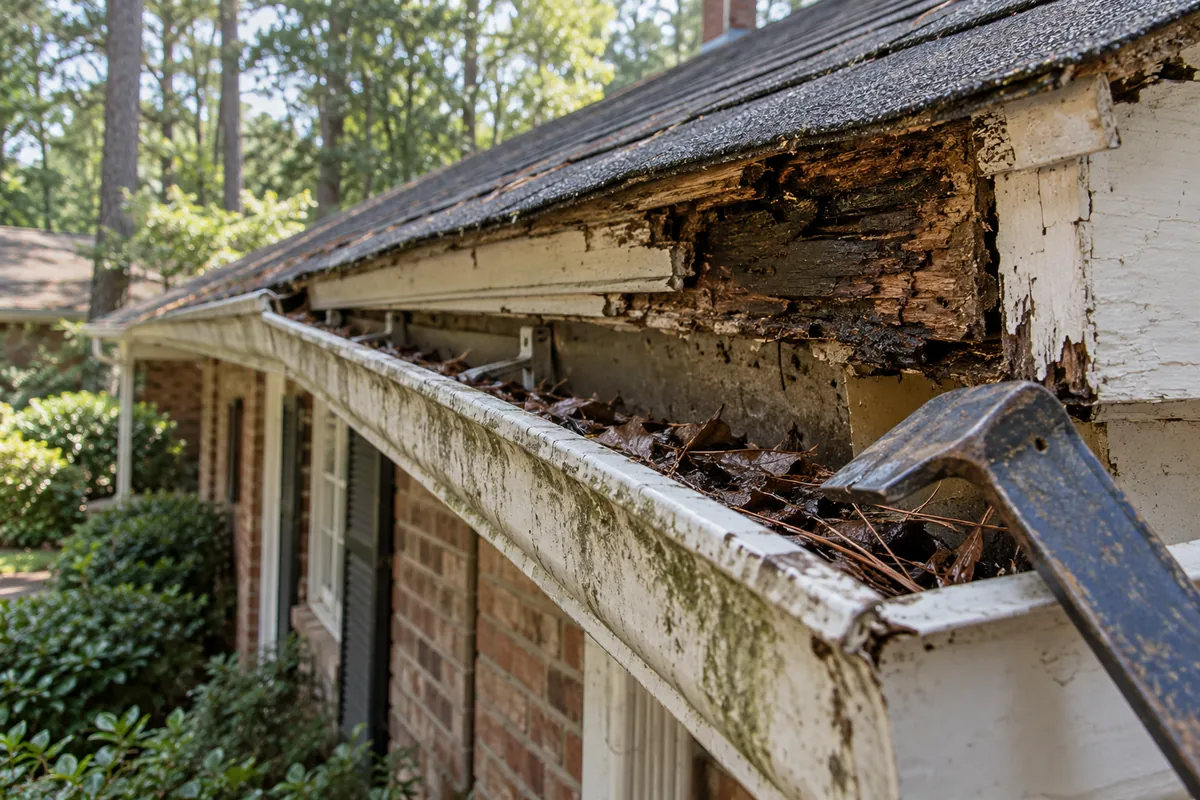
Repair or replace?
| Symptom | Repair if… | Replace if… |
|---|---|---|
| Leaking seam | One or two seams on an otherwise sound system | Seams are failing along multiple runs |
| Sagging section | Hangers are loose but the fascia is solid | The fascia is soft or the gutter is bent |
| Rust | Surface rust in one spot | Rust-through or pinholes along the trough |
| Overflow | Clogs or a blocked downspout | The gutter is undersized for the roof |
| Pulling away | One section, fixable with new hangers | Several sections, or repeated failures |
Many repairs are inexpensive — HomeGuide puts the average at $275 — so a single problem on a sound system is rarely a reason to replace. The calculation changes when several of these show up at once, or when repairs keep coming back. More detail on fixes is on the gutter repair page.
Why so many Cobb County systems are reaching the end
More homes standing in Cobb County today were built in the 1980s than in any other decade, and about 29 percent were built before 1980, according to Census figures reported by the Cobb County Courier. Homes from those decades that still carry their original or first-replacement gutters are where seams, hangers and fascia tend to fail together.
Replace the gutters and add guards in one job
When gutters are being replaced anyway, it is the cheapest moment to add gutter guards: one setup, one estimate, and guards fitted to new, properly pitched gutters instead of old ones. It is also the moment to size up to 6-inch gutters on large roof planes.
What replacement costs
Full replacement runs about $12 to $25 per linear foot installed, or $2,200 to $5,000 for a typical home, plus $50 to $200 to remove and dispose of the old system. Two-story homes add roughly $1 to $3 per foot. See gutter costs around Marietta for the full table.
What happens on replacement day
Most single-family replacements around Marietta take a day. The old gutters and downspouts come down first, which exposes the fascia; any soft boards are cut out and replaced before anything new goes up. New runs are formed on site, pitched toward the downspouts, hung on hidden hangers and sealed at the corners. Downspouts go back in the same spots or are moved where drainage was poor, and the system is run with water before the crew leaves.
Choices worth making at replacement
Replacement is the one moment when size, material and layout can all change without extra cost of tearing out something new. The common upgrades:
- Size up to 6-inch on large or steep roof planes that overflow today.
- Add downspouts where long runs drain to a single outlet.
- Move downspouts away from walkways, patios and low corners of the foundation.
- Add guards while the gutters are new and correctly pitched.
- Switch to half-round on older homes where K-style was a later substitution.
Fascia and soffit
Years of overflow usually leave the fascia behind old gutters in worse shape than it looks from the ground. HomeGuide lists fascia and soffit replacement at $4 to $22 per linear foot, and the work is far easier while the gutters are down than as a separate job later. An estimate that includes an allowance for fascia repair avoids surprises.
Comparing replacement quotes
Gutter quotes are easiest to compare per linear foot with the same specification. Before choosing, it helps to line up each quote on the same points: gutter size and gauge, hanger type and spacing, number of downspouts, removal of the old system, fascia allowance, and any guards. Two quotes that look far apart often turn out to describe different systems.
Several of these signs at once?
A local provider can tell whether repair or replacement makes more sense.